 English


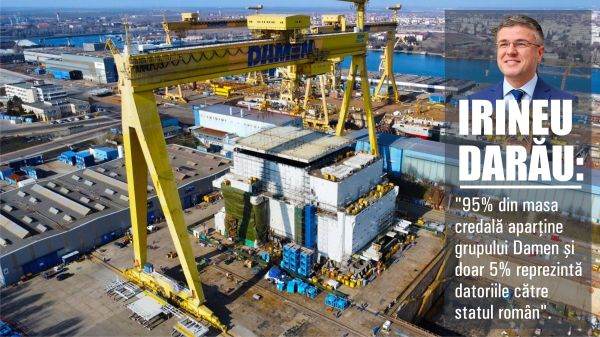
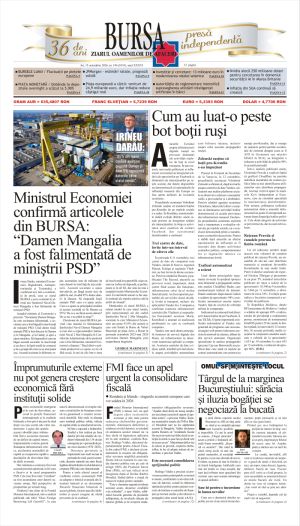
Irineu Darău, the Minister of Economy, Digitalization, Entrepreneurship, and Tourism, confirmed yesterday during a press conference what the BURSA newspaper has consistently reported over the past few years: the Damen Mangalia Shipyard was driven into bankruptcy by PSD ministers.
The current Minister of Economy stated: "The Damen Mangalia company is a bankrupt entity-a company pushed into insolvency by PSD ministers. One of the former PSD ministers served as a director at Damen-both at Mangalia and Galaţi-before becoming a minister. Let them answer for how they drove this company into insolvency, leading to a total lack of orders and a financial hole from which there was no way out. This bankrupt company-I repeat-had accumulated hundreds of millions of euros in total debt to all creditors. Indeed, in addition to taxes owed to the state, the company ended up owing 95% of its debt to Damen. Let the former PSD ministers answer for how things reached that point. How did it happen that Damen became the company's principal creditor, holding 95% of the debt? Why was this debt incurred? Why wasn't it paid on time?” When asked by the BURSA newspaper about the state's culpability in the bankruptcy of the Damen Mangalia Shipyard-and specifically the role of representatives from the 2 Mai Mangalia Shipyard on the board of the now-bankrupt entity-the Minister of Economy replied: "If an operation that was once productive has-inexcusably, in my view-slid over the years into a state of irretrievable insolvency, then certain individuals ought to be held accountable-politically, and perhaps in other ways too-though that is not necessarily the Ministry of Economy's purview. I sometimes wonder what certain state institutions are doing when they look at situations like this."
It should be noted that BURSA has previously reported on how the Romanian state-through its representatives at the 2 Mai Mangalia Shipyard (a company in which the Ministry of Economy holds over 93.9% of shares and which is listed on the Bucharest Stock Exchange's Aero market)-stalled Damen Mangalia's operations between October 2023 and May 2024 by failing to approve the budget. This had a negative impact on the operational management provided by Damen Group representatives, as their decision-making authority was curtailed or blocked by representatives of the state, which held a 51% stake in the Damen Mangalia Shipyard.
Following the bankruptcy of the shipyard in question, the state will incur no financial loss, as the facility was sold for euro138 million to the German group Rheinmetall, the Minister of Economy stated. Irineu Darău explained: "First, all outstanding taxes owed to the state are paid: 160 million lei to the state budget-specifically to ANAF-8 million lei to the Mangalia Administrative-Territorial Unit, and 10 million lei to the state-owned company Şantierul Naval 2 Mai Mangalia. Added to this is the amount paid by the state as wages-via the Wage Guarantee Fund-after the company entered insolvency and subsequently bankruptcy. The remainder of the sum paid by Rheinmetall for the acquisition of Şantierul Naval 2 Mai Mangalia will be distributed according to the pool of claims, based on the creditors to whom the bankrupt company owes money. 95% of the claims belong to the Damen Group, while only 5% represent debts owed to the Romanian state.”
However, the state received euro138 million from Rheinmetall, whereas the debts of the Damen Mangalia Shipyard amount to nearly euro400 million; this means that the Dutch Damen Group and other creditors will not be fully satisfied by the proceeds of the sale-in other words, they will not receive full or partial repayment of the debts owed to them by the company in question.
• Joint venture at the Mangalia Shipyard?
Regarding the acquisition of the shipyard, the Minister of Economy indicated that Rheinmetall purchased only the assets and that the state intends to form a joint venture with the German company for the docks and the land beneath them.
Irineu Darău stated: "Discussions are underway regarding these past few weeks with Rheinmetall regarding a partnership. There are several ways the Romanian state can partner with the German company to achieve this objective. The new operations at Mangalia must be conducted through a Romanian company, and I personally believe the right approach is for the Romanian state to be a partner in this new entity.”
When asked by the BURSA newspaper whether the state would hold a 50% or 51% stake in the new partnership (following the precedent set at Damen Mangalia), the Minister of Economy avoided giving a direct answer but noted: "It would be entirely unprofessional for me to preempt the outcome or draw conclusions before we actually have them and before negotiations have taken place. One firm point I will make is that, generally speaking, equity stakes, capital contributions, and the like must be based on concrete valuations of the assets involved-whether land or equipment. In my view, the state is often a poor manager. Therefore, I do not believe that the Romanian state holding a majority stake in a company is an objective in itself. In my opinion, it is important for the Romanian state to secure two things regarding strategic industries: first, to participate-meaning it should not be irrelevant or absent from a strategic industry or asset; and second, of course-especially in the defense industry-to have veto rights over critical matters. When dealing with situations involving the army's needs, it is only natural to be able to place priority orders for certain items.” "I believe these are the objectives of the Romanian state."
It is worth noting that when Damen Holdings took over the Mangalia Shipyard, it paid off all the debts the state should have settled with the South Korean firm Daewoo regarding DMHI; however, Damen ended up with only a 49% stake, as the Romanian state retained the majority 51% shareholding while ceding operational management to the Dutch company. Yet, this management remained dependent on decisions made by state representatives on the Damen Mangalia Board of Directors.
• A mere coincidence? Rheinmetall purchased the shipyard after the Romanian state received a 15% advance from Brussels for projects funded through SAFE
Controversy also surrounds the price Rheinmetall paid to acquire the Mangalia shipyard. According to official data, the German company paid euro138 million-funds that, according to leaders from AUR and some within the PSD, allegedly originated from the advance Rheinmetall received from the Bolojan government for projects funded via SAFE. SAFE is a financial mechanism based on low-interest loans that the Romanian state must repay to the European Commission-along with the accrued interest-within a maximum of 45 years.
Responding to these allegations, Minister Irineu Darău stated: "The Romanian state, through the Ministry of Finance, received a 15% advance for projects funded via SAFE, and this advance will be allocated to the companies with which procurement contracts have been signed." Regarding the allegations that Rheinmetall waited for this advance payment before participating in the fifth tender for the acquisition of the Mangalia Shipyard, I believe we are dealing with a case of fake news. First of all, these advances are granted by the European Commission to pre-finance projects and investments, and all localization criteria remain mandatory. Secondly, did the Romanian state-under the current government-act detrimentally or against Romania's interests by requiring any supplier signing a procurement contract to build the vessels in Romania? I do not believe it did any harm. In fact, it was in the Romanian state's interest to impose this condition: that the four vessels must be built in Romania. Consequently, regardless of the private investor's identity, they are bound by the Ministry of Economy's conditions and must seek a location to manufacture them. "It is excellent that they did it, and-I repeat-I heard that tall tale about there being other offers or a host of other interested companies; yet, neither at the 185 [million] nor at the 138 [million] mark-I have double-checked this-was there any offer whatsoever, formal or informal, at those price points from anyone else."
When asked by the media whether it was a mere coincidence that the advance payment Rheinmetall is set to receive covers at least the acquisition cost of the Mangalia Shipyard (Editor's note: 15% of the euro920 million contract for the four naval vessels amounts to euro138 million; however, it should be noted that the total value of the contracts the Rheinmetall group holds with the Romanian state stands at euro5.7 billion), the Minister of Economy stated: "There is only one thing that is not a coincidence: the fact that the Romanian state wanted-and ensured-that these ships be built in Romania. That is no coincidence; it was effectively a condition imposed by the Romanian state on any potential supplier, and in this instance, Rheinmetall was approved as the supplier by the Supreme Council of National Defence and by the defense committees of the Senate and the Chamber of Deputies. If we imposed this obligation on any supplier within SAFE-where else would you expect them to build the ships? In Asia? So, naturally, any investor included in SAFE who faces such obligations must find a location to build the vessels. That is what Rheinmetall did. The fact that there were no bids prior to Rheinmetall's offer implies something else, too: there had been political statements claiming investors were lining up-willing to pay 185 million euros or even more-yet no one specifies exactly who these investors are, given that none of them actually submitted a bid. For any investor-whether involved in SAFE-funded projects or not-the process differs from dealing with the state; fortunately for them (and unfortunately for the state), they run the financial numbers and determine how much they can invest based on the condition of the assets. It was only the state that squandered money, and we ended up in an even worse situation.”
The only conclusion to be drawn from the above is that there is currently a risk of the 2017-2026 scenario repeating itself in Mangalia. It depends entirely on Rheinmetall and future governments whether the Mangalia Shipyard will be revitalized, begin producing military and civilian vessels, become competitive, and transform into a genuine strategic economic asset.
• Share price of Şantierul Naval 2 Mai Mangalia skyrocketed immediately after the sale of Damen Mangalia to Rheinmetall
The sale of the Damen Mangalia Shipyard to Rheinmetall appears to have also benefited the state-owned company in the same sector-Şantierul Naval 2 Mai Mangalia-which held a 51% stake on behalf of the Romanian state in the business entity that had gone bankrupt.
Immediately after CITR-the judicial administrator/liquidator for Damen Mangalia Shipyard-announced the sale of the facility to Rheinmetall on October 9, trading volume for the state-owned company's shares (listed on the Aero market) surged, driving up the share price, according to data published on the Bucharest Stock Exchange website.
Shares of Şantierul Naval 2 Mai Mangalia-characterized by very low liquidity, primarily due to a small free float-posted gains of approximately 30% during the trading sessions of October 9, 12, and 13, driven by the highest... ...volumes seen since September 2017, according to data available on the Bucharest Stock Exchange (BVB) website.
Yesterday at 3:30 PM, the company's shares had fallen by 18.29% to 28.6 lei-again amidst the highest trading volumes since September 2017-a price level equating to a market valuation of 190.8 million lei. On October 8, the company's BVB valuation stood at 106.8 million lei.
It is worth noting that the low liquidity of Şantierul Naval 2 Mai Mangalia shares makes them prone to significant price fluctuations.
• Intra-group transactions: public officials' explanation for the Damen Mangalia bankruptcy
Within the Ministry of Economy, there are officials who appear to hold a different view regarding the bankruptcy of the Damen Mangalia Shipyard. During yesterday's press conference, while I was questioning Minister Irineu Darău, a ministry official behind me kept repeating that Damen held operational management of the shipyard, even though the state owned a 51% stake in the facility. At the end of the meeting, she even suggested I look into intra-group transactions, noting that-as confirmed by ANAF audits-these had driven up the shipyard's debt.
Sources close to the Damen Group, whom I contacted immediately after the press conference, stated that ANAF officials had alleged that, regarding the modernization of the Mangalia shipyard, those... ...from the Damen group brought in equipment and machinery from other subsidiaries-such as the Damen Galaţi Shipyard-and the prices involved were allegedly excessive. Essentially, public officials claim that these intra-group acquisitions were made at prices unjustified by actual costs, though they fail to specify the methodology used to determine that the purchase prices were too high.
In my view, the public officials' claims seem absurd, given that Damen held operational management of the Mangalia facility; it was only natural for company representatives to utilize the same technology and equipment at the new shipyard that they had already been successfully employing for years at the Galaţi Shipyard.




















 Euro
Euro Dolar SUA
 Franc elveţian
 Liră sterlină
 Gram de aur































Reader's Opinion